Performance Marketing
Performance Marketing Explained: How It Works, Types, Benefits & Careers
How performance marketing works, the main channels, the metrics that matter, its benefits and limitations — and how to build a career in it.
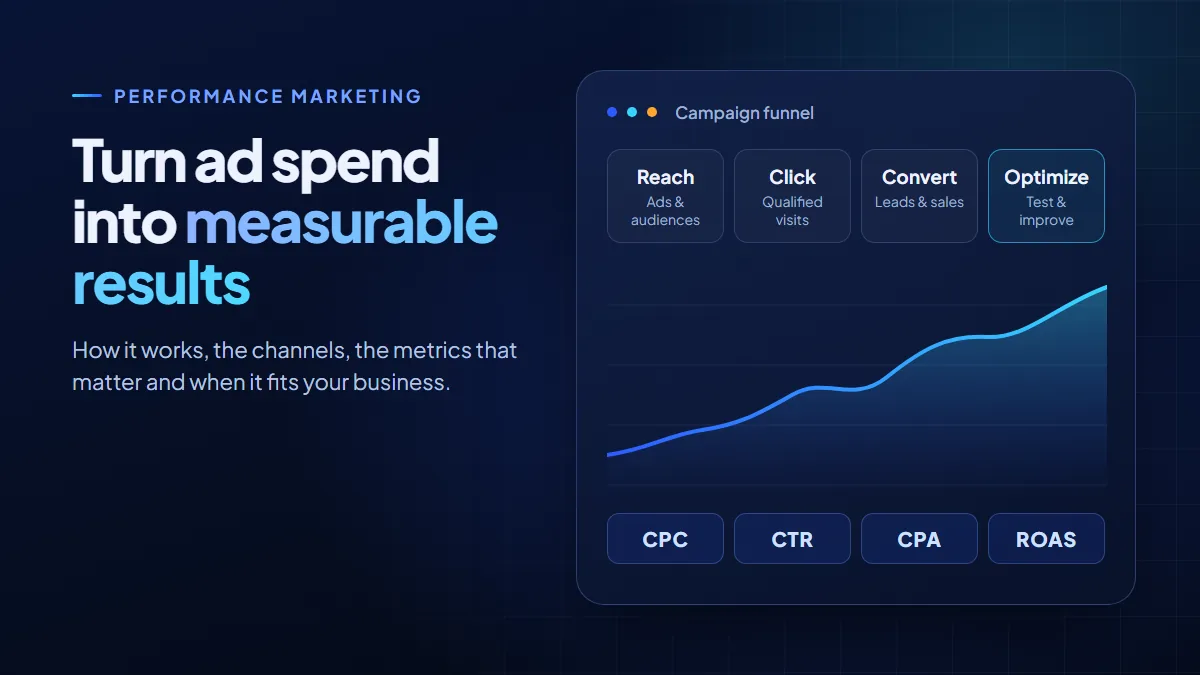
Performance marketing is one of the most talked-about areas of digital marketing — and one of the most misunderstood. At its core, the idea is simple: you invest in marketing, measure the specific actions it produces and keep improving whatever delivers the best return.
This guide explains how performance marketing works, the main channels, the metrics you need to understand, its benefits and limitations, and how to start a career in the field. It’s written for business owners deciding whether to invest in it and for beginners who want to learn it properly.
- Performance marketing measures success by actions — leads, sales, sign-ups or calls — not just reach.
- Reliable conversion tracking must be in place before you spend, or optimization becomes guesswork.
- CPL, CPA and ROAS tell you what results cost; lead quality and profit tell you whether they’re worth it.
- It works best alongside brand building, a clear offer and landing pages that convert.
What is performance marketing?
Performance marketing is a results-focused approach to digital marketing in which campaigns are planned, measured and optimized around specific actions such as clicks, leads, purchases, app installs or phone calls. Instead of judging a campaign only by how many people saw it, you judge it by what those people did — and what each of those actions cost.
The term describes both a way of measuring marketing and, in some channels, a way of paying for it. Common pricing models include:
- Cost per click (CPC): you pay when someone clicks your ad — typical for search advertising.
- Cost per thousand impressions (CPM): you pay for exposure but still optimize toward conversions — common on social and display platforms.
- Cost per acquisition or lead (CPA/CPL): you pay, or bid, based on a completed action.
- Commission or revenue share: partners are paid a percentage of the sales they generate — the model behind most affiliate programs.
So “performance” doesn’t always mean you only pay when a sale happens. It means every decision — budget, targeting, creative and landing page — is guided by measurable outcomes.
How does performance marketing work?
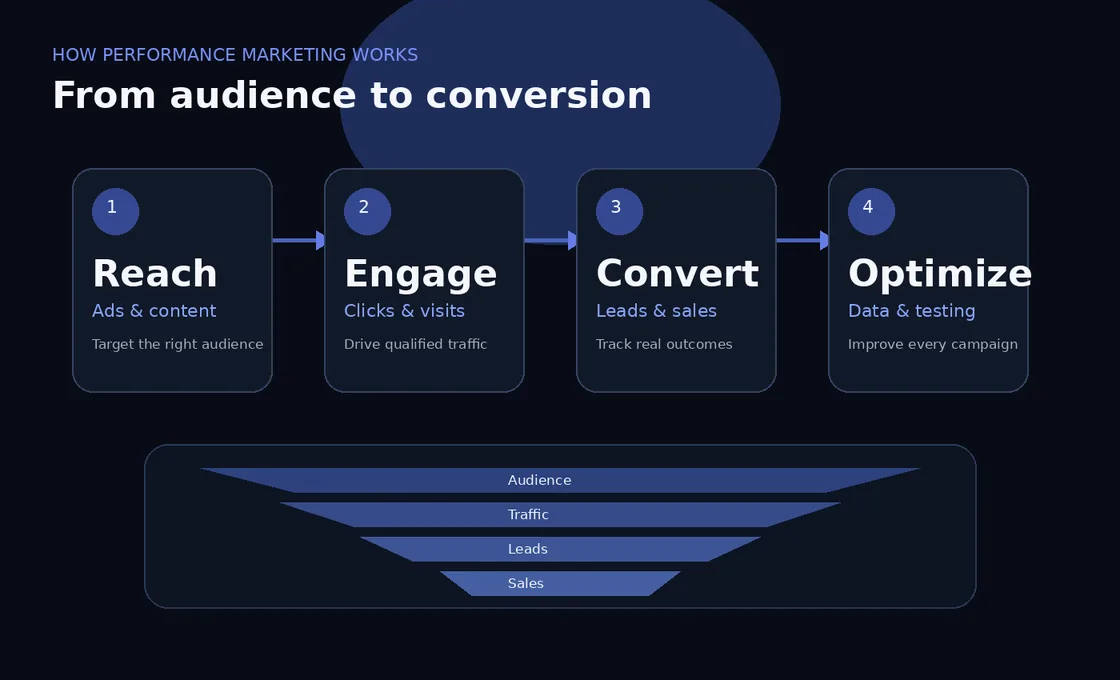
Most successful performance marketing programs follow the same cycle:
- Define the goal and what it’s worth. Decide which action matters most — a qualified lead, a purchase or a booked call — and roughly how much you can afford to pay for it while staying profitable.
- Set up tracking before launch. Install and test conversion tracking in Google Analytics 4 and each ad platform you use, so every form submission, call or purchase is recorded correctly.
- Choose channels based on intent. Search ads capture people who are already looking for a solution. Social and display ads create demand among people who match your audience but aren’t searching yet.
- Launch with a test budget. Start with a budget large enough to gather meaningful data, using a few focused campaigns rather than many thin ones.
- Analyze and optimize. Compare cost per result across campaigns, audiences, keywords, ads and landing pages. Pause what underperforms and test new variations against what works.
- Scale carefully. Increase budget gradually on proven campaigns, and check that cost per result and lead quality hold steady as spend grows.
Types of performance marketing
Performance marketing isn’t a single channel. These are the most common ones, and most businesses use a combination.
Paid search advertising
Search ads, such as Google Ads and Microsoft Advertising, appear when people search for specific keywords. Because the searcher has already expressed a need, paid search is often the most direct route to leads and sales. Costs are usually charged per click, and keyword choice, ad relevance and landing page quality all influence results.
Paid social advertising
Platforms such as Facebook and Instagram (Meta Ads), LinkedIn and TikTok let you reach people based on interests, demographics, behaviour, job role or similarity to your existing customers. Social ads are strong at generating new demand and at retargeting people who have already visited your website.
Display and retargeting
Display ads appear on websites and apps across advertising networks. They’re often used for retargeting — showing relevant ads to people who visited your site but didn’t convert — and for reaching specific audiences at scale.
Affiliate marketing
In affiliate marketing, partners such as publishers, creators or comparison websites promote your product using unique tracking links. When a customer completes a qualifying action, such as a purchase, the affiliate earns a commission. Because you mainly pay for results, affiliate programs can be cost-efficient — but they need clear terms and monitoring to prevent low-quality or misleading promotion.
Shopping and marketplace ads
E-commerce businesses can promote individual products in shopping results and online marketplaces, with images and prices shown in the ad itself. These campaigns depend on accurate product data and bidding that takes product margins into account.
Key performance marketing metrics
Metrics are the language of performance marketing. These are the ones you’ll see most often:
| Metric | What it tells you | How to calculate it |
|---|---|---|
| CTR (click-through rate) | How compelling your ad is to the people who see it | Clicks ÷ impressions × 100 |
| CPC (cost per click) | What you pay, on average, for each visit | Ad spend ÷ clicks |
| CVR (conversion rate) | How well your landing page and offer turn visits into actions | Conversions ÷ clicks × 100 |
| CPL (cost per lead) | What each enquiry or sign-up costs | Ad spend ÷ leads |
| CPA (cost per acquisition) | What each new customer or sale costs | Ad spend ÷ acquisitions |
| ROAS (return on ad spend) | How much revenue each unit of ad spend generates | Revenue from ads ÷ ad spend |
Imagine a campaign spends 50,000 (in any currency) and receives 2,000 clicks, 80 leads and 20 sales worth 200,000 in revenue:
- CPC = 50,000 ÷ 2,000 = 25
- Lead conversion rate = 80 ÷ 2,000 × 100 = 4%
- CPL = 50,000 ÷ 80 = 625
- CPA per sale = 50,000 ÷ 20 = 2,500
- ROAS = 200,000 ÷ 50,000 = 4 (often written as 4:1 or 400%)
Whether those numbers are “good” depends entirely on your margins and customer value. A ROAS of 4 can be very profitable for a business with high margins and loss-making for one with thin margins. That’s why the most useful targets come from your own economics — profit per sale, lead-to-customer rate and customer lifetime value — rather than generic benchmarks.
For lead generation, also track lead quality: how many leads become qualified opportunities and paying customers. A campaign with a low CPL that produces unqualified enquiries is usually worse than one with a higher CPL and better customers.
Benefits of performance marketing
- Measurable spend. You can see what a click, lead or sale costs and which campaigns produce them, so budget decisions are based on evidence.
- Fast feedback. Campaigns start generating data within days, which makes it possible to test offers, messages and audiences quickly.
- Flexible budgets. Spend can be increased, reduced, paused or moved between campaigns as results change.
- Precise targeting. Keywords, audiences, locations, devices and schedules let you focus on the people most likely to convert.
- Scalable growth. Once a campaign is profitable, budget can be increased gradually while you monitor cost per result.
- Insights beyond ads. Search terms, winning messages and conversion data can improve your website, content and sales conversations too.
Limitations and common mistakes
Performance marketing is powerful, but it isn’t a guaranteed growth machine. Watch out for these issues:
- Unreliable tracking. Missing or duplicated conversions lead to wrong decisions. Privacy controls, cookie consent and cross-device behaviour also mean no setup captures everything, so treat platform data as directional and check it against real sales.
- Optimizing for cheap leads. Ad platforms will find whatever you ask them to optimize for. If you optimize for any form submission, you may get many low-quality ones.
- Weak landing pages. More clicks won’t fix a confusing page, a slow mobile experience or an unclear offer.
- Over-relying on last-click attribution. The final click before a conversion rarely tells the whole story. Search ads often capture demand that social media, content or word of mouth helped create.
- Ignoring brand. People are more likely to click and convert when they already recognize and trust a business. Performance campaigns usually work better with brand building and content running alongside them.
- Scaling too quickly. Sharp budget increases can push campaigns into less relevant audiences and raise costs. Scale in steps.
Performance marketing vs digital marketing
Digital marketing is the broad field that includes SEO, content, social media, email, paid advertising and more. Performance marketing is the part most strongly focused on measurable actions and paid acquisition.
| Aspect | Digital marketing | Performance marketing |
|---|---|---|
| Scope | All online marketing: SEO, content, social media, email, ads and your website | Mainly paid channels and affiliates optimized around conversions |
| Main goal | Visibility, trust, engagement and growth over time | Specific, measurable actions at an efficient cost |
| Typical metrics | Traffic, rankings, engagement, leads and revenue | CPC, CPL, CPA, conversion rate and ROAS |
| Timeframe | Short and long term — SEO and content compound over time | Short feedback loops, measured continuously |
The two work best together: SEO and content build demand and trust, while performance marketing captures and accelerates it. For a broader view of how the pieces fit, read our practical guide to digital marketing.
What does a performance marketing analyst do?
A performance marketing analyst turns campaign data into decisions. Typical responsibilities include:
- Monitoring KPIs such as CPC, CPL, CPA and ROAS across ad platforms
- Building reports and dashboards that explain what changed and why
- Analyzing search terms, audiences, placements and creatives to find wasted spend
- Planning and evaluating A/B tests for ads and landing pages
- Checking that conversion tracking is accurate and consistent
- Recommending budget shifts between campaigns and channels
How to start a performance marketing career
- Learn the fundamentals. Understand funnels, audiences, offers and the metrics in this guide. The free learning programs from the ad platforms themselves — such as Google Skillshop and Meta Blueprint — are a good starting point.
- Get comfortable with analytics. Learn Google Analytics 4, conversion tracking basics and spreadsheets. Being able to explain why numbers changed is as valuable as running campaigns.
- Practice on real projects. Run a small campaign for your own project, a friend’s business or a non-profit. Document the goal, setup, results and what you’d change.
- Build supporting skills. Copywriting, landing page basics, audience research, A/B testing and basic SEO all make you a stronger performance marketer.
- Create a simple portfolio. Short, honest write-ups of what you tested and learned are more convincing than certificates alone.
Is performance marketing right for your business?
Performance marketing is usually a good fit when you have a clear offer, a website or landing page that can convert, the ability to track leads or sales and a budget you can commit long enough to learn from the data. If those foundations are missing, fixing them first will usually achieve more than increasing ad spend.
If you’d like help assessing your setup, our performance marketing service covers strategy, campaign management and optimization, and our analytics and conversion tracking service makes sure the numbers you rely on are accurate.
Frequently asked questions
What is paid performance marketing?
Paid performance marketing uses advertising platforms such as Google Ads and Meta Ads to generate measurable actions — website visits, leads, purchases or app installs — while tracking what each result costs.
How does affiliate marketing work?
An affiliate receives a unique tracking link, promotes the offer through content, email or advertising, and earns a commission when a customer completes an eligible action such as a purchase.
How much budget do I need to start?
There’s no universal minimum. Your test budget should be large enough to generate a meaningful number of clicks and conversions within a few weeks, which varies by industry and competition. Starting with one focused campaign is usually better than spreading a small budget across many.
Is performance marketing good for small businesses?
It can be, especially when the business has a clear offer and can track enquiries or sales. Smaller budgets benefit most from narrow targeting, strong landing pages and careful tracking.
What skills are needed for performance marketing?
Data analysis, ad platform knowledge, audience research, conversion tracking, copywriting, A/B testing and a working understanding of business economics such as margins and customer value.
How is performance marketing different from traditional advertising?
Traditional advertising, such as print, TV or outdoor media, is mainly bought for reach and awareness and is harder to connect to individual actions. Performance marketing is built around trackable digital actions and continuous optimization.
Conclusion
Performance marketing gives businesses something traditional advertising rarely could: a clear view of what marketing spend produces. But results depend on the foundations — accurate tracking, a strong offer, landing pages that convert and decisions based on real business value rather than surface-level metrics.
Start with one clear goal, measure it properly and improve step by step. That discipline, more than any single platform or tactic, is what makes performance marketing work.