Business Strategy
SWOT Opportunities Examples for Business: Types, Ideas & How to Identify Them
What counts as an opportunity in a SWOT analysis, practical examples for business, marketing, HR and sales, and a simple framework for turning opportunities into strategy.
Businesses don’t grow only because they have a good product or a strong team. Growth can also come from changes outside the business: new customer needs, emerging technology, new markets, changing buying habits, partnerships and gaps in the competition. These external changes become valuable opportunities when a business knows how to identify them — and act on them.
In a SWOT analysis, opportunities are the external factors that may help a business grow, improve its position, reach new customers or develop new products and services. This guide explains what counts as an opportunity, gives practical examples for business, marketing, HR and sales, and shows how to turn opportunities into a strategy.
What are opportunities in SWOT analysis?
Opportunities are external conditions or trends that a business may be able to use to its advantage. Unlike strengths and weaknesses, which describe the business itself, opportunities come from the market or the wider environment.
| Origin | Helpful | Harmful |
|---|---|---|
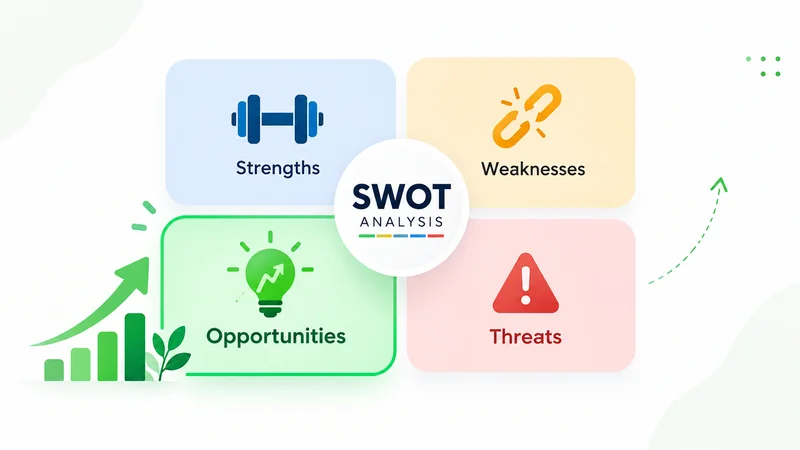
| Internal | Strengths | Weaknesses |
| External | Opportunities | Threats |
Common sources of opportunities include changing customer needs, new technology, growing markets, new digital channels, competitor gaps, strategic partnerships, new customer segments, industry trends and changes in regulation or buying behaviour.
Specific opportunities are far more useful than broad ones. “More customers” is too vague to act on. A clearer opportunity would be: “Growing interest in online consultations creates an opportunity to offer a remote version of our service.” The more specific the opportunity, the easier it is to connect your SWOT analysis to a practical business strategy.
SWOT opportunities examples for business
Here are common types of opportunities, each with a simple illustrative example.
1. Entering a new market
A business may discover demand for its products or services in a new city, region, country, industry or customer segment. Example: a software company that serves schools finds that training institutes face the same scheduling problem.
2. Growing customer demand
Changes in customer preferences can reveal opportunities. If more people are looking for a particular product or service, a business can consider developing an offer around that demand. Example: a bakery receives repeated requests for eggless and low-sugar options.
3. Using new technology
Technology can create opportunities to improve operations, automate repetitive tasks, develop new services or deliver a better customer experience. Example: an accounting firm adds online booking and secure document upload to serve clients faster.
4. Expanding digital channels
A business that depends mainly on offline sales or referrals may be able to reach new customers through SEO, social media, email marketing, e-commerce or online advertising. Example: a furniture maker that sells through a showroom launches an online catalogue with enquiry forms.
5. Finding competitor gaps
Competitor research can reveal customer needs that aren’t being served well — slow response times, confusing pricing, poor support or missing services. Example: competitor reviews show customers are frustrated by long delivery times, creating an opportunity to compete on speed.
6. Building strategic partnerships
Partnerships with complementary businesses can provide access to new audiences, skills, distribution channels or resources. Example: a wedding photographer partners with venues and planners for referrals.
7. Launching new products or services
New customer problems or market trends can create room for new offers. The key is to connect the offer to a real, validated need. Example: a web design studio adds website maintenance plans after clients repeatedly ask for ongoing support.
8. Responding to market trends
Industry changes can create opportunities before they become mainstream. Monitoring customer behaviour, competitor activity and search trends helps businesses spot these changes early. Example: a fitness studio adds online classes as more members ask for flexible schedules.
Marketing SWOT analysis example
Consider a small, hypothetical digital marketing agency reviewing its position:
| SWOT area | Example |
|---|---|
| Strength | Experienced team with strong SEO and paid advertising skills |
| Weakness | Limited brand awareness and few published case studies |
| Opportunity | More businesses want help measuring and improving their online visibility |
| Threat | Increasing competition from other agencies, freelancers and automated tools |
The opportunity isn’t simply “SEO is popular”. A more useful statement is: “More businesses want to measure and improve their online visibility, which creates an opportunity to offer a clear SEO audit and reporting package.” That statement connects an external change with a possible business action, which makes it useful for planning.
Human resources SWOT analysis: opportunity examples
Human resources teams can identify opportunities by looking at changes in the employment market and workplace technology. Examples include:
- Remote and hybrid working arrangements that widen the talent pool
- Online training and skill-development programs
- Wider recruitment platforms and professional communities
- AI-assisted and automated administrative processes
- Employer branding through digital channels
For example, remote work may create an opportunity to recruit skilled people from a wider geographic area instead of limiting recruitment to one local market.
Sales SWOT analysis: opportunity examples
Sales opportunities often come from changes in customer behaviour, distribution channels or market demand. Examples include:
- Targeting new customer segments or industries
- Launching e-commerce or online ordering
- Entering new geographic markets
- Cross-selling or upselling related services to existing customers
- Creating referral and partner programs
- Using social selling and online lead generation
A company that previously depended on physical stores, for example, may identify e-commerce as an opportunity to reach customers outside its existing locations.
How to identify opportunities in SWOT analysis
Instead of guessing, work through structured questions:
- What customer needs are growing or changing?
- What changes are happening in our industry?
- Are customers moving to new platforms or buying channels?
- Is new technology changing how customers buy or use products?
- Are competitors leaving important customer needs underserved?
- Could we enter a new market or customer segment?
- Could a partnership give us access to new customers or capabilities?
Frameworks such as PESTLE — political, economic, social, technological, legal and environmental factors — help you scan the external environment systematically so important changes aren’t missed.
Where to find evidence
An opportunity becomes credible when it’s supported by evidence. Useful sources include:
- Customer conversations: repeated questions, requests and complaints
- Sales and enquiry data: which products, services or regions are growing
- Search data: Google Search Console, keyword research tools and Google Trends
- Competitor research: their websites, offers and customer reviews
- Industry sources: trade publications, associations and reputable reports
A practical rule: an opportunity is ready to act on when it has three parts — an external change, evidence that it’s real and a possible action.
Opportunities vs threats in SWOT
| Opportunities | Threats |
|---|---|
| External positive factors | External negative factors |
| Can create growth possibilities | Can create business risks |
| New market demand | New competitors |
| New technology | Disruptive technology |
| New partnerships | Changing regulations |
Review both together, because the same external change can be an opportunity for one business and a threat for another. A new technology might help one company serve customers more efficiently while making another company’s main service less relevant.
How to turn SWOT opportunities into business strategy
A SWOT analysis only becomes valuable when its findings lead to action. A simple framework is:
- OpportunityThe external change you’ve noticed
- EvidenceData showing it’s real
- ActionWhat you’ll do about it
- GoalThe measurable result you want
Here’s an illustrative example:
- Opportunity: Customers increasingly ask whether the service can be delivered online.
- Evidence: Enquiry records show repeated requests, and Search Console shows impressions for searches that mention “online”.
- Action: Launch an online version of the service with its own landing page.
- Goal: Generate enquiries from customers outside the current service area.
You can then weigh each opportunity against your resources, customer demand, timing and expected impact before deciding what to pursue first.
Match opportunities with strengths (the TOWS approach)
The TOWS matrix extends SWOT by pairing the factors together. The most attractive strategies often come from strengths–opportunities (SO) combinations: using what you already do well to capture an external opportunity. Weaknesses–opportunities (WO) strategies focus on fixing a weakness so you can take advantage of an opportunity.
Common mistakes when identifying SWOT opportunities
- Writing opportunities that are too vague to act on
- Confusing internal strengths with external opportunities
- Making assumptions without evidence
- Listing every possible trend instead of the most relevant ones
- Ignoring competitor activity
- Identifying opportunities without deciding what action should follow
A focused SWOT with a few well-supported opportunities is usually far more useful than a long list.
Frequently asked questions
What are opportunities in SWOT analysis?
Opportunities are external conditions, trends or changes that a business may be able to use for growth or improvement.
What are five examples of business opportunities?
New markets, growing customer demand, new technology, new digital channels and strategic partnerships are common examples.
What is a marketing SWOT analysis example?
For a digital marketing agency, growing demand for measurable online visibility can be an opportunity, while increasing competition from other agencies and automated tools may be a threat.
How do you identify opportunities in SWOT?
Review customer needs, market trends, technology, competitors, new channels and industry changes, then validate the most important findings with evidence such as customer feedback, sales data and search data.
Are opportunities internal or external?
In a traditional SWOT framework, opportunities are external. Strengths and weaknesses describe internal factors, while opportunities and threats describe external ones.
Conclusion
Opportunities in SWOT analysis help businesses look beyond what they already have and examine what’s changing around them. New customer needs, technology, markets, partnerships and digital channels can all create possibilities for growth.
The goal isn’t to list every possible opportunity. It’s to identify the relevant ones, support them with evidence and turn them into practical actions. If one of your opportunities involves reaching more customers online, our practical digital marketing guide is a good next read — or talk to us about building a digital marketing strategy around it.